Choosing laser power for industrial work is not simply a matter of selecting the highest available wattage. Material type, thickness, process speed, beam quality, and production goals all influence the correct decision. The question “how to select laser power for industrial applications” requires practical judgment, verified data, and controlled testing. More power is not always better.
A reliable assessment begins with the material and the intended process. Engineers examine whether the system will cut, weld, mark, clean, or drill. Stainless steel, aluminum, carbon steel, plastics, and composites absorb laser energy differently. A 3 kW fiber laser may cut thin stainless steel efficiently, while a thicker plate may require higher power and slower movement. However, excessive power can widen the kerf, increase heat-affected zones, or damage delicate surfaces. That answer is incomplete. Beam quality, focal position, nozzle design, assist gas, and duty cycle also matter. Manufacturer specifications and applicable safety standards should support every recommendation.
This guide explains how to match laser power with material thickness, process speed, and required finish. It also considers energy efficiency, maintenance demands, operating cost, and future production changes. Test cuts and weld samples provide stronger evidence than calculations alone. Measurements matter. Operators should record penetration, edge quality, cycle time, and energy use during trials. No calculator replaces validation. A sensible decision balances performance, reliability, and safety, while accepting that laboratory results may change on a busy factory floor. Careful review remains necessary before approving a final configuration.
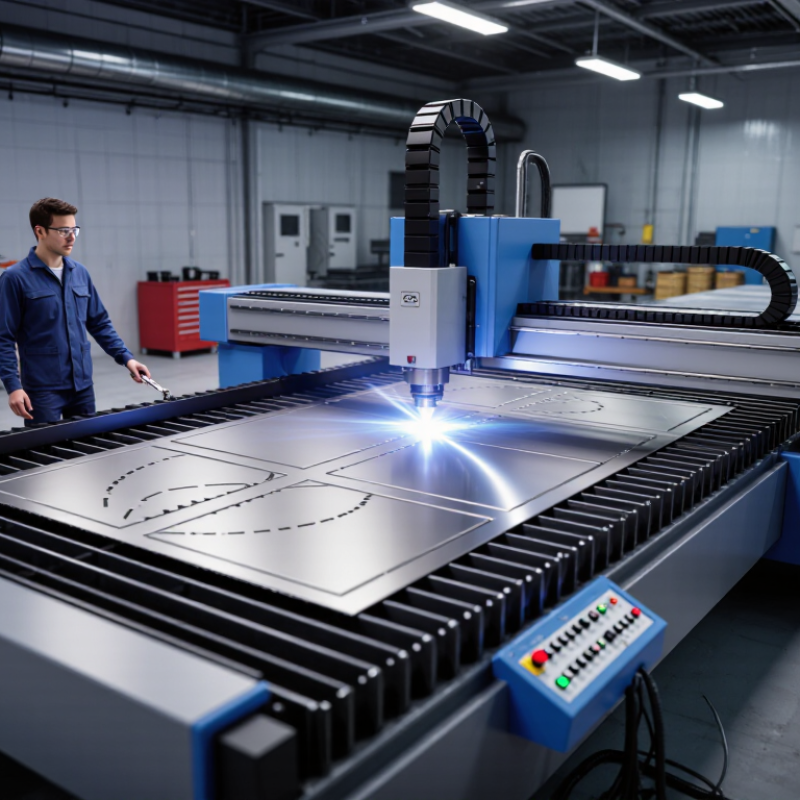
Define the Material and Industrial Processing Requirements
Selecting laser power starts with defining the material, not choosing the largest available source.
Identify the material grade, thickness, surface condition, and reflectivity. Steel, aluminum, copper, plastics, and coated sheets absorb energy differently. Thermal conductivity also affects melting and heat transfer. A clean, uncoated surface may process very differently from an oily or oxidized one.
Then define the industrial task clearly.
Cutting needs stable penetration, controlled kerf width, and limited heat-affected zones. Welding requires penetration depth, joint fit-up, travel speed, and acceptable distortion. Marking usually needs lower power and precise pulse control. Cleaning applications may depend more on pulse energy and surface sensitivity than average power.
Specify the required tolerance, production rate, cycle time, and duty cycle before testing.
Small details matter.
Spot size, focal position, scan speed, and assist-gas pressure can change results significantly. A higher power setting is not automatically better. It may create dross, warping, discoloration, or unnecessary energy use.
That shortcut can fail.
Run controlled trials on representative samples.
Record power, speed, frequency, focus position, and material temperature. Inspect edges, weld cross-sections, surface damage, and repeatability. Operators should compare several settings instead of trusting one successful sample. Real production conditions are rarely perfect. Material batches vary, and fixtures can introduce small alignment errors. Leave a practical operating margin, but avoid excessive power that hides poor process control.
Match Laser Power to Cutting, Welding, Marking, or Engraving Tasks
How to Select Laser Power for Industrial Applications?
Power selection starts with the task, not the machine’s maximum rating. Cutting usually needs higher continuous power for thick metal and steady penetration. Thin sheet may require less power, a smaller spot, and faster travel. Welding depends on joint design, material conductivity, and the required penetration depth. Too much power can create excessive heat, distortion, or an oversized heat-affected zone. Marking often needs lower power and controlled pulses. Engraving may need moderate power, repeated passes, or slower movement to produce a clean, visible depth.
Tips: Test on the actual material whenever possible. Record power, speed, pulse frequency, focus position, and assist-gas settings. Check the cut edge under magnification. A rough edge often signals poor focus or excessive speed, not insufficient power. Reflective materials need extra caution and suitable process controls. Confirm the laser’s duty cycle, cooling capacity, and work envelope before production.
In practical trials, operators sometimes increase power when results look weak. That can hide the real problem. I have seen poor focus mistaken for low energy. A simple focus check corrected the issue faster than changing the source. For welding, inspect bead width and penetration through sample sections. For marking, compare contrast after cleaning, not immediately after processing. Material batches can respond differently. Keep a small test matrix for each thickness and finish. Perfect settings rarely transfer unchanged.
Laser power should be matched to the process, material, thickness, and required production speed. Marking and engraving commonly use tens to hundreds of watts, welding typically requires sub-kilowatt to multi-kilowatt systems, and industrial cutting often uses 1–20 kW or more for thick or high-throughput materials. These ranges are typical planning values rather than fixed equipment specifications.
Evaluate Beam Quality, Efficiency, Cooling, and Operating Costs
Selecting laser power for industrial work requires more than matching wattage to material thickness. Beam quality determines how efficiently power reaches the workpiece. A clean, tightly focused spot can produce narrower kerfs, smoother welds, and less heat distortion. For cutting, examine penetration depth and edge condition. For welding, inspect bead shape, fusion depth, and spatter. Trial data is more reliable than catalog figures.
Tips: Test the lowest practical power first. Measure twice. Record speed, focus position, gas flow, and surface temperature during each trial. A small thermal camera or power meter can reveal problems that visual inspection misses. Do not judge performance from one sample; material coatings and batch variation can change results.
Electrical efficiency also affects operating costs. A system drawing excessive power may erase savings from faster processing. Cooling demand matters, especially during long shifts. Check chiller capacity, airflow, coolant temperature, and filter condition before increasing power. Maintenance downtime should enter the calculation, not remain an afterthought. I have seen power estimates look excellent until cooling and idle consumption were added. That mistake is easy to repeat. A practical comparison includes electricity, consumables, maintenance, rejected parts, and operator time. Some applications need higher peak power, but not continuous maximum output. Duty cycle can protect components and reduce unnecessary energy use.
How to Select Laser Power for Industrial Applications? – Evaluate Beam Quality, Efficiency, Cooling, and Operating Costs
| Laser Source |
Typical Industrial Output Power |
Beam Quality (M²) |
Wall-Plug Efficiency |
Cooling Requirement |
Recommended Power-Selection Range |
Relative Operating-Cost Index* |
Common Applications |
| Fiber Laser |
1–20 kW |
1.05–1.30 |
25–40% |
Closed-loop water chiller; moderate heat rejection |
1–6 kW for sheet metal; 6–20 kW for thick plate and high-throughput cutting |
1.0–1.5 |
Metal cutting, welding, cladding, additive manufacturing |
| Direct Diode Laser |
1–10 kW |
5–30 |
35–55% |
Closed-loop water cooling; high cooling capacity at high power |
2–6 kW for surface treatment and welding; 6–10 kW for broad-area processing |
0.9–1.4 |
Heat treatment, brazing, cladding, polymer and composite processing |
| Disk Laser |
1–20 kW |
1.10–1.50 |
15–30% |
Precision temperature-controlled chiller; high stability required |
2–8 kW for precision welding; 8–20 kW for thick-section processing |
1.3–1.8 |
Precision welding, automotive components, aerospace structures |
| CO₂ Laser |
1–20 kW |
1.5–3.0 |
8–15% |
Closed-loop water chiller; larger electrical and thermal infrastructure |
1–4 kW for nonmetals and thin materials; 4–12 kW for selected metal cutting |
2.0–3.5 |
Acrylic, wood, textiles, plastics, glass, and some metal cutting |
| Diode-Pumped Solid-State Laser |
0.5–4 kW |
1.2–2.5 |
10–20% |
Water cooling; careful control of crystal and diode temperature |
0.5–2 kW for welding and marking; 2–4 kW for specialized processing |
1.8–3.0 |
Fine welding, marking, micromachining, and reflective-metal processing |
Selection guidance: Choose the lowest power that achieves the required penetration, travel speed, and duty cycle with an adequate process margin. Higher power does not automatically improve productivity when beam quality, material absorption, shielding gas, optics, or part positioning are limiting factors.
*Relative operating-cost index: 1.0 represents the lowest expected combined operating burden within this comparison. The index considers electrical consumption, cooling demand, consumables, maintenance, and typical service requirements; actual costs vary by duty cycle, local energy prices, material, and machine configuration.
Technical note: M² is a beam-quality factor; a value closer to 1 indicates a beam that can be focused more tightly. Efficiency and power ranges are representative industrial values and should be verified against the final laser, optical train, and process conditions.
Validate the Selected Power Through Testing and Process Optimization
How to Select Laser Power for Industrial Applications?
Selecting laser power should begin with the material, thickness, geometry, and production speed. A higher rating does not automatically produce better results. Excess power can widen the heat-affected zone, distort thin parts, or create rough edges. Lower power may leave incomplete penetration and unstable cuts. Record the target kerf width, surface finish, penetration depth, and acceptable cycle time before testing.
Tips: Run a controlled trial matrix using several power levels and speeds. Change one variable at a time, or use a designed experiment for complex processes. Inspect cross-sections under magnification. Measure roughness, burr height, dimensional accuracy, and energy use. Keep the material batch, nozzle distance, focus position, and assist-gas conditions consistent. Small changes matter.
A clean first cut can mislead. In practical trials, a setting may perform well for ten parts and fail after thermal buildup. Test repeated cycles, not only single samples. Check the workpiece immediately and after cooling. We once treated discoloration as cosmetic, but it later indicated excessive heat input. That assumption required correction. Process logs should include actual output power, pulse behavior, travel speed, and maintenance status. Qualified operators should verify protective controls and follow applicable safety requirements. Power is validated when quality remains stable across realistic production conditions.
Conclusion
Selecting the correct laser power is essential for achieving stable, efficient, and high-quality industrial processing. To understand how to select laser power for industrial applications, begin by identifying the material type, thickness, surface condition, and required production volume. The application also matters: cutting may require concentrated power for penetration, while welding, marking, and engraving depend on different combinations of energy, precision, and heat control. Power should be evaluated together with processing speed, beam focus, energy density, and duty cycle rather than as an isolated specification.
A practical selection process should also consider beam quality, electrical efficiency, cooling requirements, maintenance needs, and long-term operating costs. Higher power is not always the best choice if it creates excessive heat, reduces detail, or increases expenses without improving output. After choosing an initial power range, validate it through controlled testing. Adjust speed, focus, pulse settings, and material handling conditions to optimize quality and productivity. This testing phase helps confirm that the selected laser power meets both technical requirements and real production goals.

 Kinray Laser