Manufacturers are asking, “why is laser marking replacing traditional printing methods?” The answer begins on the factory floor. A laser creates permanent marks without ink, plates, solvents, or drying time. On a metal housing, the result can be a sharp serial number that survives oil, heat, and repeated handling.
The market evidence is also moving. MarketsandMarkets’ 2024 Laser Marking Market report estimates growth from about USD 3.1 billion in 2024 to USD 4.7 billion by 2029. Grand View Research reports a similar expansion, driven by automation, traceability, and demand for non-contact production. These figures are estimates, not guarantees. Research firms use different definitions and forecasting models.
Klaus Löffler, a laser technology executive at TRUMPF, has described laser marking as “a precise, flexible process that supports reliable industrial identification.” That view reflects practical experience. A laser head can mark a barcode on a tiny connector, then switch to a logo on a larger enclosure. No ink cartridge change is needed.
The benefits are tangible. Less consumable storage. Fewer smudged codes. Faster line changes. Digital control can also reduce setup errors and improve data traceability.
Still, the replacement story is incomplete. Laser systems can cost more initially. Reflective materials may require careful parameter control. Poor ventilation or incorrect settings can reduce quality and safety.
Traditional printing remains useful for large, low-cost runs. Laser marking is not a universal winner. It is becoming the stronger choice where permanence, accuracy, automation, and clean production matter most.
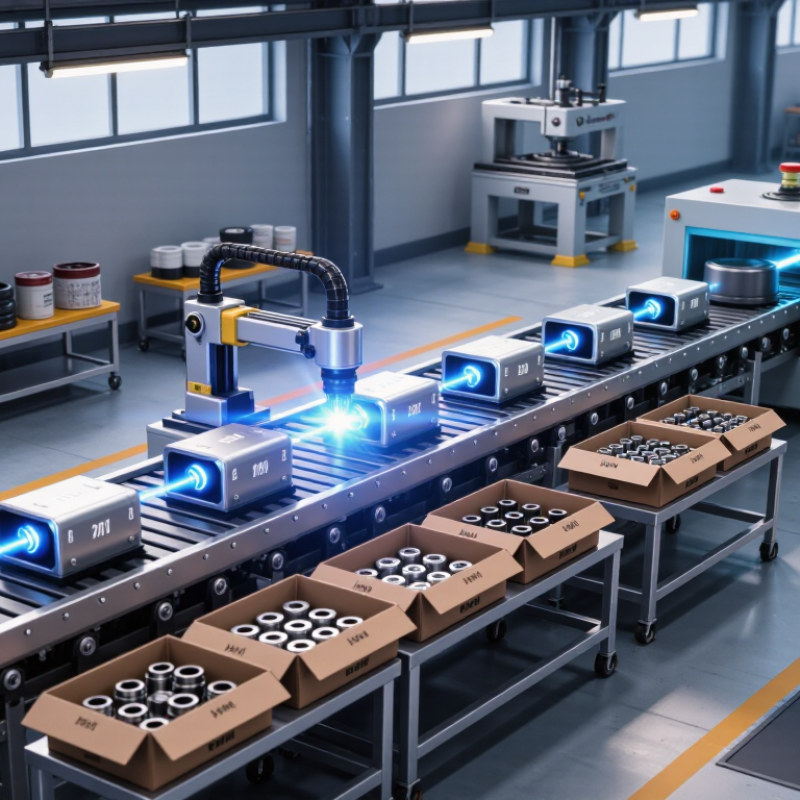
Laser marking uses a concentrated beam of light to change a material’s surface permanently. Unlike ink printing, it does not require cartridges, wet drying time, or physical contact. A lens focuses the beam into a tiny spot, while scanning mirrors guide it across the selected area. The laser’s energy then creates a controlled color change, shallow groove, or surface reaction.
The process depends on material behavior. On stainless steel, heat can create a dark annealed mark without removing much material. On plastic, the beam may produce contrast through foaming or gentle surface ablation. Wood, glass, and coated parts need different settings. Power, speed, pulse frequency, and focus must work together. Small changes can affect readability.
In practical production, technicians test samples before approving a marking program. They check contrast, depth, edge sharpness, and resistance to rubbing or cleaning. A code may look clear under bright light but fail in a warehouse. That detail is easy to overlook. Laser marking is not automatically perfect. Dust, uneven surfaces, poor focus, and excessive heat can damage the result. Careful calibration and regular inspection make the process more reliable. This balance helps explain why manufacturers increasingly use laser marking for serial numbers, dates, measurements, and traceable product information.
Traditional printing is losing its advantages as packaging lines demand more variable data, shorter runs, and less material waste. Plates, inks, solvents, and drying time increase setup work. They also create recurring purchasing and maintenance costs. On a busy line, changing a batch code can mean cleaning rollers and checking registration again.
Laser marking removes several of these steps. It writes directly onto suitable surfaces, leaving sharp characters without ink cartridges or wet curing. Operators can mark serial numbers, dates, and 2D codes seconds before dispatch. According to Smithers’ 2024 packaging analysis, the global digital packaging print market is projected to grow from about 22 billion US dollars in 2023 to 36 billion by 2028. That growth reflects demand for shorter, more flexible production runs.
The change is not perfect. Laser systems need careful testing for contrast, heat effects, and substrate compatibility. Dark plastic may produce weak readability, while sensitive films can deform. GS1 guidance also stresses that machine-readable codes require consistent contrast and verification, not merely visible marks. Traditional printing still performs well for large, fixed designs. Yet its waste becomes harder to justify when every order needs different information. A missed calibration can still cause failures. That uncomfortable detail deserves attention.
Why Is Laser Marking Replacing Traditional Printing?
Key Benefits of Laser Marking for Modern Manufacturing
Laser marking is moving from specialist equipment to everyday production lines. MarketsandMarkets’ 2024 industry report estimates the laser marking market at about USD 3 billion in 2023. It also projects a value above USD 5 billion by 2028, with annual growth near 10%. This rise reflects a practical need: manufacturers want permanent identification without ink, solvents, plates, or drying time.
The mark stays on the surface.
In factory use, laser systems can produce serial numbers, barcodes, and small safety symbols directly on metal, plastic, glass, and coated parts. There is less contact with the workpiece, so delicate components face lower mechanical stress. Maintenance can also become simpler because operators are not replacing cartridges or cleaning print heads. The European Commission’s energy-efficiency guidance identifies reduced consumables as an important advantage of dry, contactless production processes.
Traceability improves when markings remain readable after heat, abrasion, or routine cleaning. That matters in automotive, electronics, medical equipment, and industrial tooling. However, laser marking is not automatically perfect. Incorrect power or focus can create weak contrast, surface damage, or unreadable codes. Material testing remains essential. In one production trial, even a small change in surface coating affected clarity under barcode scanning. The equipment also requires trained operators, ventilation controls, and careful process validation. Traditional printing still fits some high-speed, decorative applications better.
Laser marking is replacing traditional printing in many industries because it creates durable identification without inks, plates, or frequent tool changes. In automotive plants, laser systems mark engine parts, brake components, and electrical connectors with serial numbers and traceability codes. The result is permanent. It can survive oil, abrasion, heat, and routine cleaning.
Medical equipment manufacturers use laser marking on stainless steel instruments, surgical trays, and coated devices. Aerospace suppliers mark aluminum panels, titanium components, and high-temperature alloys. Electronics producers apply tiny codes to circuit boards, cables, and plastic housings. Packaging also benefits, especially with glass bottles, cardboard, and certain films. Each material reacts differently. Dark plastics may form a pale contrast, while metal often needs surface annealing or controlled engraving.
Laser marking can improve readability and reduce consumable waste, but it is not automatically better for every application. A poorly chosen power level may discolor plastic, weaken a surface, or create unclear characters. Testing matters. Production teams should check contrast, depth, speed, and long-term resistance under real handling conditions. Even dust on a lens can affect consistency. Some traditional printing methods remain more practical for large, low-cost batches. Laser marking works best when manufacturers value traceability, precision, and flexible data changes, but careful setup still decides the final quality.
| Industry | Common Materials | Typical Marking Purpose | Why Laser Marking Is Preferred | Durability | Typical Laser Process |
|---|---|---|---|---|---|
| Automotive | Steel, aluminum, coated metals, engineering plastics | Part numbers, barcodes, safety information, traceability codes | Produces permanent, high-contrast marks without labels, inks, or frequent consumable changes | Very high | Annealing, engraving, or ablation |
| Electronics | ABS, polycarbonate, ceramics, silicon, anodized aluminum | Serial numbers, component identification, QR codes, polarity symbols | Non-contact processing supports small components and reduces mechanical stress | High | Surface foaming or ablation |
| Medical Devices | Stainless steel, titanium, medical plastics, glass | Unique device identification, batch codes, scales, instrument names | Permanent marks can withstand cleaning, sterilization, and repeated handling | Very high | Annealing or engraving |
| Aerospace | Titanium, nickel alloys, aluminum, composites | Permanent identification, maintenance records, inspection codes | High precision and contact-free marking help preserve critical part geometry | Very high | Engraving or annealing |
| Food and Beverage | Paperboard, glass, PET, HDPE, aluminum cans | Expiry dates, lot numbers, barcodes, recycling information | Fast, ink-free coding reduces consumables and supports variable-data printing | Medium to high | Surface marking or color change |
| Pharmaceuticals | Glass, aluminum foil, coated cartons, polymer containers | Batch codes, expiration dates, serialization data | Digital control enables accurate, readable variable marking with minimal material contact | High | Ablation or surface discoloration |
| Industrial Equipment | Carbon steel, stainless steel, aluminum, painted surfaces | Asset numbers, control labels, calibration information, warning symbols | Marks remain legible under abrasion, oils, heat, and industrial cleaning | Very high | Deep engraving or ablation |
| Tools and Hardware | Tool steel, carbide, stainless steel, aluminum | Size markings, logos replaced by neutral identifiers, batch tracking | Creates precise marks on curved or irregular surfaces without printing plates | Very high | Engraving or annealing |
| Consumer Goods | Wood, leather, glass, coated metals, plastics | Decorative graphics, personalization, product information | Supports short runs, customization, and rapid design changes without physical screens or plates | Medium to high | Engraving or surface color change |
| Jewelry and Accessories | Gold, silver, platinum, stainless steel, gemstones | Fine text, serial numbers, personalization, decorative patterns | Fine focused beams produce detailed marks on small items with limited physical force | High | Engraving or surface discoloration |
| Cables and Wires | PVC, PE, cross-linked polyethylene, fluoropolymers | Length markings, cable specifications, batch and compliance codes | Permanent contrast can be produced continuously without ink drying or label replacement | High | Foaming or surface ablation |
| Renewable Energy | Glass, aluminum, silicon, coated metals, polymers | Panel identification, electrical ratings, serial numbers, installation data | Durable, traceable markings support outdoor exposure and long service intervals | Very high | Annealing, ablation, or engraving |
| Note: Durability depends on the material, laser wavelength, marking depth, surface preparation, and environmental exposure. Traditional printing remains useful for some high-speed, disposable, or large-area applications, while laser marking is especially suitable for permanent identification, variable data, customization, and low-consumable production. | |||||
Choosing between laser marking and traditional printing starts with the material, not the machine. Laser systems work well when codes must resist abrasion, heat, moisture, or cleaning chemicals. They also avoid ink, solvent, and plate changes. The mark is permanent. That matters on metal tools, plastic components, and serialized parts. Start with the substrate.
Traditional printing remains practical for colorful graphics, large filled areas, and high-volume packaging. It can deliver strong visual impact at low unit cost. However, changing artwork may require new plates, setup time, or extra material. A production trial should compare contrast, readability, cycle time, and rejected parts. Small details often change the decision.
Industry forecasts support careful selection rather than automatic replacement. MarketsandMarkets estimates the laser marking market could grow from about 3.7 billion dollars in 2023 to 5.7 billion dollars by 2028. Smithers projects the global digital print market for packaging and labels to reach roughly 36.9 billion dollars by 2028. These figures show expanding demand for both technologies, not a universal winner. For variable data, low waste, and permanent identification, laser marking usually has an advantage. For broad color coverage and decorative packaging, printing may still perform better. Energy use also deserves testing; laser equipment is not automatically the greener option. A real comparison should measure total cost, ventilation, maintenance, and operator training over several production cycles.
Laser marking uses a focused light beam to change a material’s surface permanently. It creates contrast, shallow grooves, or controlled surface reactions. No ink is required.
A lens focuses the beam into a tiny spot. Scanning mirrors guide it across the selected area. Energy changes the surface in a programmed pattern.
Stainless steel, plastic, wood, glass, and coated parts can be marked. Each material needs different power, speed, pulse, and focus settings. One setting rarely fits everything.
Laser marking handles variable dates, serial numbers, and codes without plates or ink cartridges. It also avoids wet drying time and direct contact. This can reduce setup work and material waste.
Traditional printing suits colorful graphics, broad filled areas, and large fixed designs. It may offer a lower unit cost during very high-volume production. Laser is not always the winner.
Technicians should test samples before approving the marking program. They should inspect contrast, depth, edge sharpness, and cleaning resistance. A clear mark can still fail in a dim warehouse.
Dust, uneven surfaces, poor focus, and excessive heat can weaken or damage marks. Dark plastic may show poor contrast. Sensitive films can deform. Small settings matter.
Not automatically. It can reduce ink, solvent, and plate waste. However, energy use, ventilation, maintenance, and training still require measurement. A real comparison needs several production cycles.
Compare material compatibility, readability, cycle time, rejected parts, and total cost. Also test abrasion, heat, moisture, and cleaning resistance. I would test again after real line conditions.
Laser marking is a modern identification process that uses a focused beam of light to alter the surface of a material, creating clear, permanent marks without ink, plates, or physical contact. This overview explains why is laser marking replacing traditional printing methods, especially as manufacturers seek greater efficiency, flexibility, and long-term traceability. Traditional printing can require consumables, regular maintenance, drying time, and frequent adjustments when production information changes, making it less efficient for demanding applications.
The article highlights laser marking’s key benefits, including high precision, durability, fast digital control, low material waste, and reduced operating requirements. It also explores its use across industries such as electronics, automotive production, medical equipment, packaging, and general manufacturing, covering materials including metal, plastic, glass, wood, and coated surfaces. Finally, it explains how to choose between laser marking and traditional printing by considering production volume, material type, required permanence, marking speed, appearance, and overall operating costs.

Kinray Laser